




Does four-wheel drive mean your truck can pull a trailer through anything winter throws at Long Island? It's one of the most common questions truck owners bring to Town & Country Jeep Chrysler Dodge Ram in Levittown once the first cold snap hits. The honest answer is no, and knowing why can keep you, your rig and the people around you safe all season.
- Myth: 4WD Gets You Through Anything (What It Actually Changes)
- Myth: More Traction Means More Control (What It Doesn't Change)
- Myth: A Heavy Truck Stops Fine on Its Own (Braking With a Trailer)
- Myth: The Speed Limit Is a Safe Speed (Winter Towing Speeds)
- Myth: A Quick Walk-Around Is Enough (Pre-Trip Checks for Cold-Weather Towing)
- Myth: You Can Sort It Out Once It Snows (What to Do Next)
- Key takeaways
Myth: 4WD Gets You Through Anything (What It Actually Changes)
Fact: four-wheel drive is about getting power to the ground. When you shift into 4WD, the transfer case sends engine torque to the front axle as well as the rear, so all four tires share the job of pushing. On a snowy boat ramp, an unplowed driveway or a slushy on-ramp to the Long Island Expressway, that's a real advantage.
A rear-drive truck with a loaded trailer can spin its back tires and go nowhere. With 4WD engaged, you have a far better chance of rolling forward smoothly and holding your momentum up an icy grade, where the trailer's weight is working against you.
Using it the right way
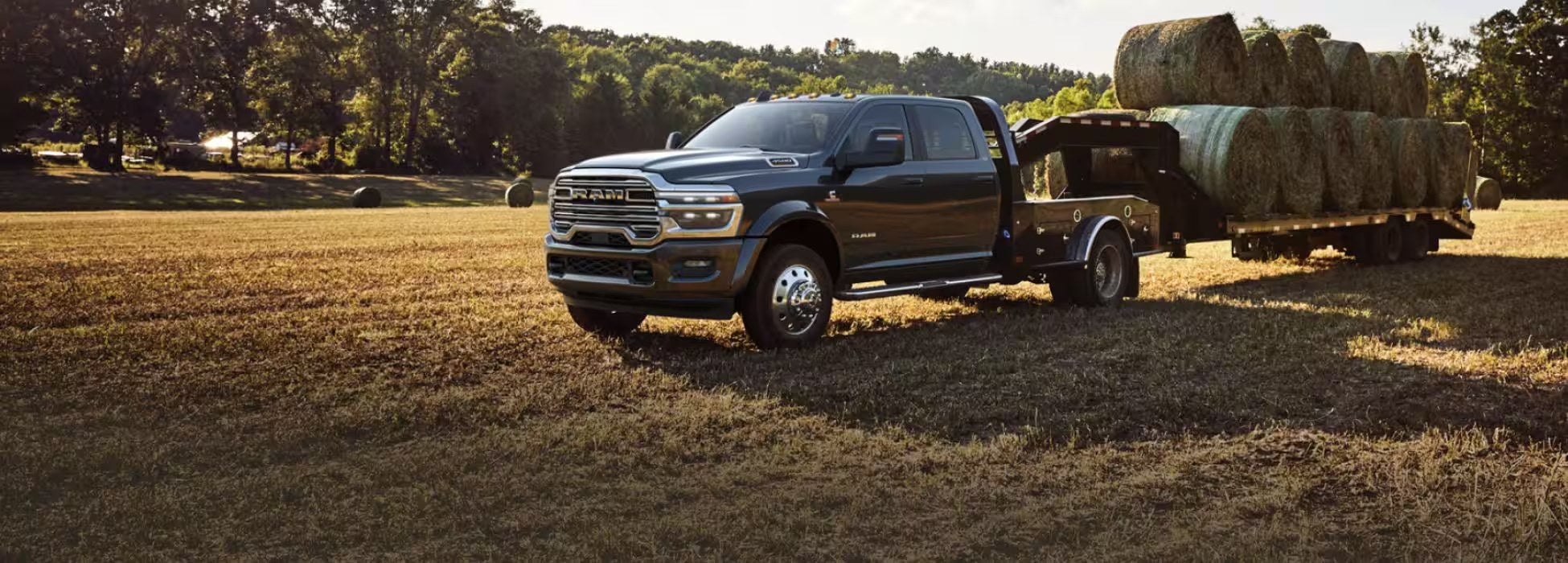
Many heavy-duty trucks, the Ram 2500 among them, offer a part-time system with high and low ranges. A few habits make it work for you:
- Use 4HI on snow, slush or ice at normal road speeds.
- Save 4LO for crawling, like pulling a boat up a slick ramp or backing a trailer out of deep snow.
- Shift back to 2WD on dry, clear pavement, since part-time systems can bind and wear when the tires can't slip.
Your owner's manual spells out the exact shifting procedure for your truck, including when you need to be stopped or rolling slowly.
Myth: More Traction Means More Control (What It Doesn't Change)
Fact: grip to accelerate is not the same as grip to turn or stop. Your tires have only so much hold on a slick road, and 4WD doesn't create more of it. It simply spreads the engine's push across more tires. Once you lift off the gas and need to steer or slow down, a 4WD truck has the same rubber on the same ice as a 2WD one.
That's where false confidence creeps in. Because the truck pulls away so easily, it feels planted, and drivers carry more speed than the road can support. Trouble usually shows up in a curve or a lane change, when it's too late to fix.
Trailer sway is its own problem
A trailer that starts to wag behind you is reacting to speed, crosswinds, passing trucks and how its load is placed. Four-wheel drive has no influence on any of that. What helps:
- Loading so a healthy share of the weight sits ahead of the trailer axle, never behind it.
- A weight-distributing hitch with sway control for larger trailers.
- Easing off the throttle and steering smoothly if sway starts, then using the brake controller's manual lever to apply the trailer brakes alone and pull it back in line.
The Ram 2500 adds electronic trailer-sway control, which is a smart backup. Good loading and sensible speed still do most of the work.
Myth: A Heavy Truck Stops Fine on Its Own (Braking With a Trailer)
Fact: your brakes were never part of the 4WD system. Any vehicle on the road brakes with all four wheels, so engaging four-wheel drive adds nothing when you press the pedal. Hook up a loaded trailer and the total weight you're trying to stop climbs sharply, while the grip available on ice stays exactly where it was.
Here's the physics in plain terms: more mass needs more distance to stop, and less grip needs more distance still. Put both together on a freezing night on Sunrise Highway and your stopping distance can stretch well beyond anything you're used to.
Making the brakes you have work better
- Set your brake controller gain for the conditions. A setting that feels right on dry pavement can lock the trailer wheels on ice. Test it at low speed in an empty lot before you head out.
- Use tow/haul mode so the transmission holds lower gears and helps slow the rig on downgrades.
- If your diesel has an exhaust brake, consider switching it off on icy roads, since sudden engine braking through the rear wheels can start a skid.
- Brake early and gently, and keep the wheels straight whenever you can.
Think of the trailer brakes as doing their fair share. When they're adjusted well, the rig stops as one unit instead of the trailer shoving the truck.
Myth: The Speed Limit Is a Safe Speed (Winter Towing Speeds)
Fact: posted limits assume good weather and a vehicle without a trailer. New York's basic speed rule asks you to drive no faster than is reasonable and prudent for conditions, whatever the sign says. With a trailer behind you on a slick road, that usually means well under the limit.
Experienced towers live by a few simple rules:
- Leave at least double the following distance you'd use on a dry day, and more on ice.
- Keep cruise control off on wet, snowy or icy pavement so you control every change in speed.
- Check your trailer tires' speed rating, since many trailer tires are rated below the highway speeds your truck could reach on its own.
- Stay in the right lane and let faster traffic go by.
Plan the route, not just the pace
On Long Island, the parkways are off-limits to trailers, so your route will lean on the LIE, Sunrise Highway and local roads. Bridges and overpasses freeze before the pavement around them, and wind across open stretches near the shore can push a tall, boxy trailer around.
If conditions are getting worse rather than better, the smartest move is often to wait a few hours. Plowed, salted roads are a very different drive from the first hour of a storm.
Myth: A Quick Walk-Around Is Enough (Pre-Trip Checks for Cold-Weather Towing)
Fact: cold weather changes things you checked back in July. Tire pressure drops as temperatures fall, grease stiffens, and road salt eats at wiring and connectors. A few extra minutes before you hook up pays off.
On the truck
- Tire pressure set cold to the door-placard figure for towing, with tread that still has real bite.
- Washer fluid rated for freezing temperatures and wipers that clear cleanly.
- Mirrors adjusted so you can see the trailer's full length on both sides.
On the trailer
- Lights and turn signals tested with someone watching, because salt corrodes plugs and pins fast.
- Breakaway cable attached to the truck and the breakaway battery charged.
- Safety chains crossed under the tongue, hitch pin and clip in place, coupler fully latched.
- Trailer tires and brakes inspected, and snow and ice cleared off the roof so they don't fly off at the car behind you.
Rinse the hitch, connector and trailer underside after salty trips, and let the plug dry before you store it. If something looks worn or a light keeps flickering, you can book service and have it sorted before your next haul.
Myth: You Can Sort It Out Once It Snows (What to Do Next)
Fact: the best time to prepare is before the first storm. Shops fill up once the snow starts, so get a cold-weather inspection on the calendar early. Ask for a look at brakes, tires, battery and cooling system, along with the transfer case and front axle, which may have sat unused since last winter.
Practice matters just as much. Hook up in an empty lot on the first slushy morning, test the brake controller, and get a feel for how the rig stops and turns before you need it on a crowded road. Ten minutes of low-speed practice teaches more than any article can.
Thinking about a new truck?
If your current truck is due for replacement, drive a new Ram 2500 with your own towing in mind. Bring a list of what you pull and where you take it, and book a test drive so you can try the 4WD controls, trailering cameras and tow/haul settings for yourself.
Town & Country Jeep Chrysler Dodge Ram serves Nassau, Suffolk and Queens. Our online trade-value tools and payment calculators let you see where you stand before you visit, so your time at the store goes into the truck itself.
Levittown, NY
- 4WD on your Ram 2500 helps you get moving and keep pulling, but it doesn't help you stop or steer a sliding trailer.
- Slow down and leave at least double your usual following distance whenever you tow on slick roads.
- A pre-trip check of tires, trailer brakes, lights and hitch matters more in winter than which wheels are driven.
FAQ Common questionsShould I leave 4WD engaged on the highway when towing in snow?Use 4HI when the road is covered in snow, slush or ice, and shift your Ram 2500 back to 2WD once the pavement is clear and dry. Part-time systems can bind on dry roads. Keep your speed down either way, because 4WD won't help you stop. Is all-wheel drive just as good as 4WD for winter towing?Neither one shortens stopping distances. For heavier trailers, a heavy-duty truck like the Ram 2500 gives you a true low range for slow, controlled pulling on slick ramps and driveways, which is a big help when you're moving serious weight in snow. How should I set my brake controller for icy roads?Start lower than your dry-road setting and test at low speed in an empty lot. You want the trailer to brake firmly without locking its wheels. Many Ram 2500 trucks offer an integrated trailer brake controller, which makes adjusting it on the go simple. Do I need special tires to tow in winter?Tires matter more than the drive system. Make sure your truck's tires have deep tread rated for snow, set them cold to the towing pressure on the door placard, and check the trailer's tires for wear, cracking and the right pressure too. Can I take my trailer on the Southern State or Northern State Parkway?No. Trailers aren't allowed on Long Island's parkways, so plan routes around the LIE, Sunrise Highway and local roads. If you're towing out of Levittown often, a Ram 2500 set up for trailering makes those routes easier to manage in any season. |
Want to see it in person? Come by for a test drive, or browse what is on the lot right now. Or call (516) 271-3278 · 3156 Hempstead Tpke, Levittown |